So buy it/make it once doesn’t mean zero maintenance.
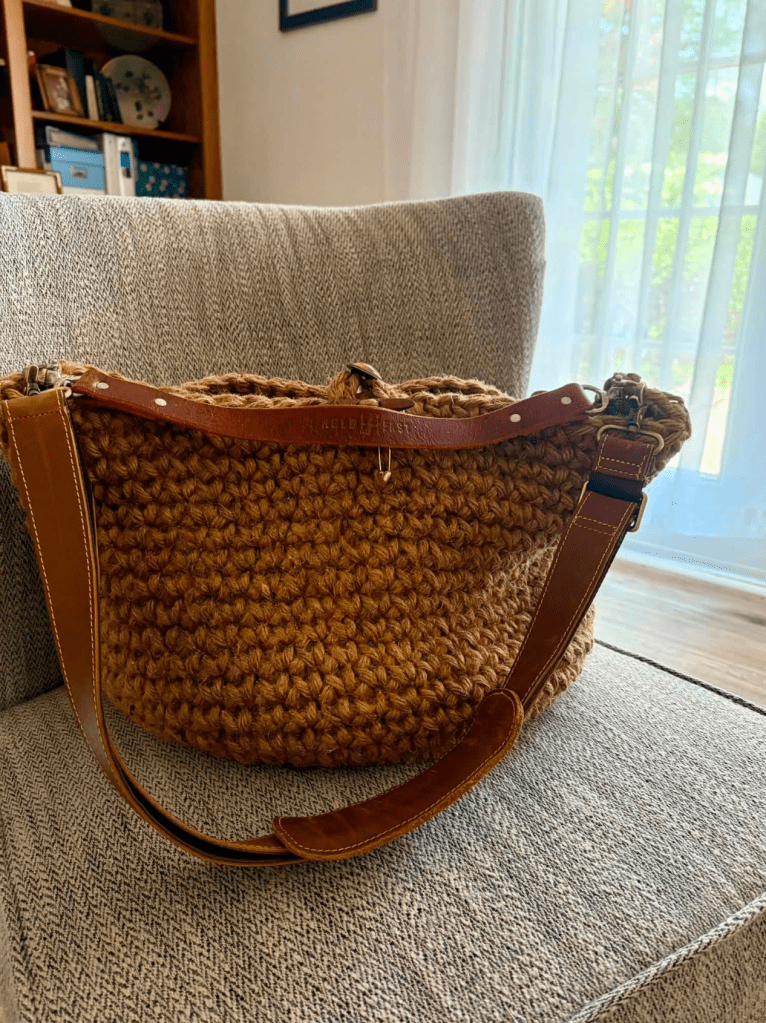
When I made this 6-ply jute crochet jute bag in February or so, I waxed it with melted beeswax then.
But beeswax wears down, so it has to be reapplied occasionally.
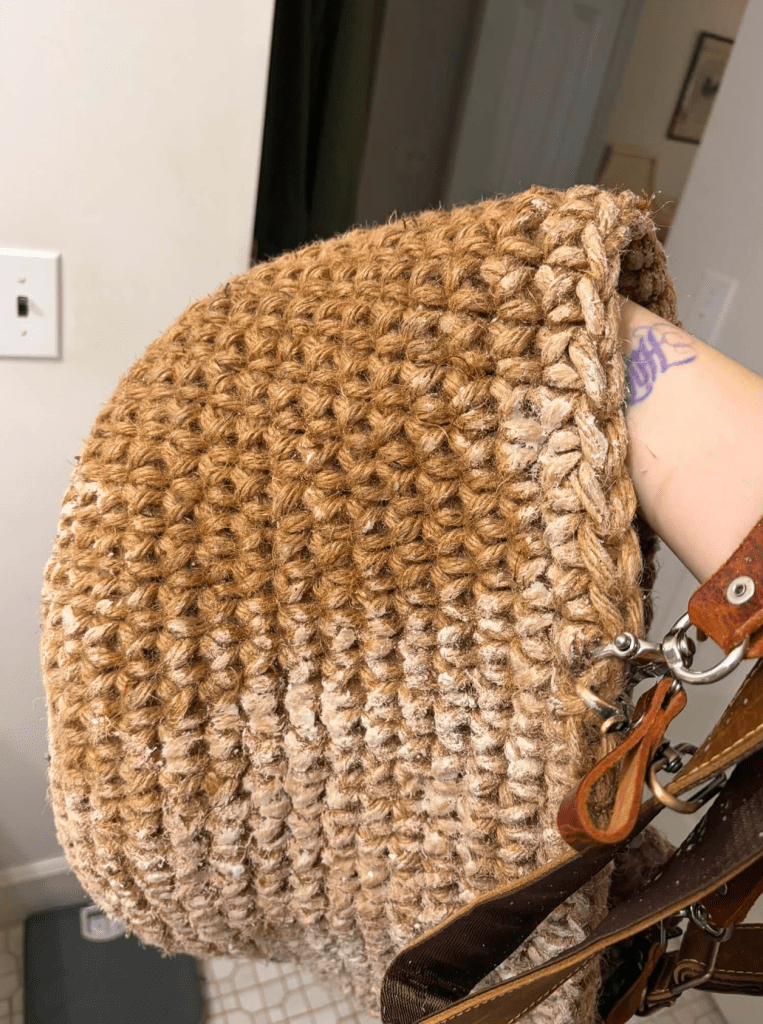
And the waxing cuts down on the jute shedding but does not eliminate it. So, the whole bag has to be emptied and vacuumed out and I used tape to catch the fibers still caught after the vacuuming.
And then I melted my wax, and used the dedicated brush I have for this purpose and went over the whole thing in the kitchen with melted beeswax. Then I went to our bathroom and used the hair dryer on high to melt the beeswax into the bag.
I did the waxing process twice when I made the bag to begin with, but doing it again every few months is probably going to be a good thing, at least for a while.
And while I didn’t do it when I put the straps on, I used leather conditioner on the straps today, too.
The longer luggage strap is permanently affixed— I used 2-part jeweler’s epoxy to permanent close the clasps to the bag.
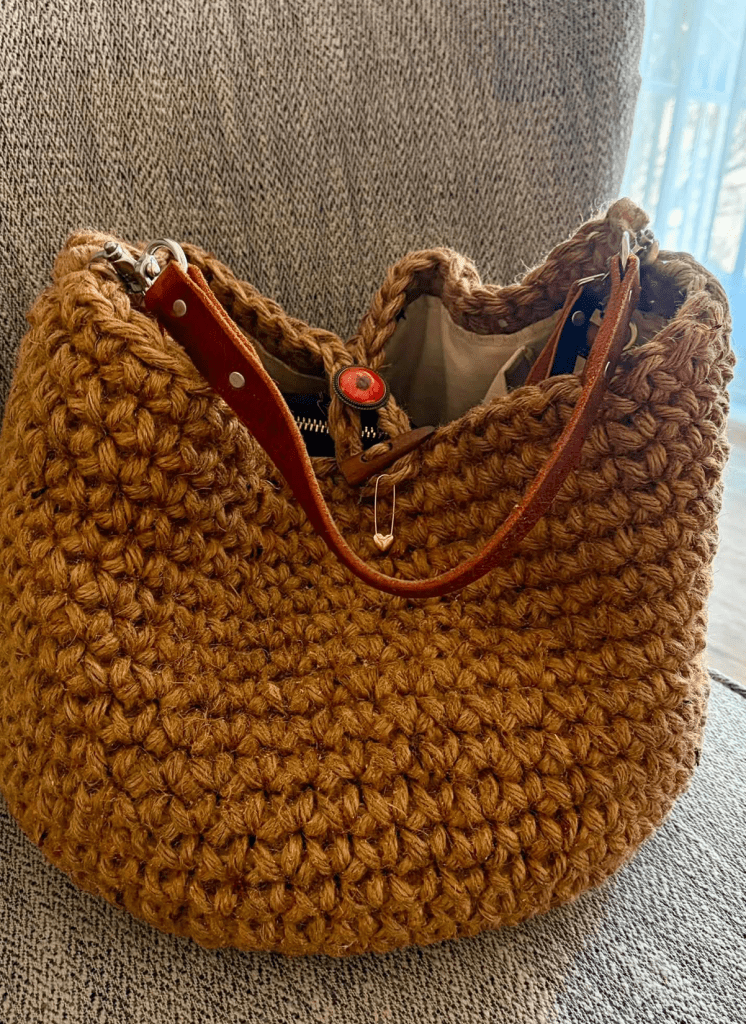
Mama and Daddy gave me the 16 inch Holdfast stabilizer in 2018 or 2019, and it is perfect for days that I want a shorter strap— the luggage strap tucks in the bottom of the bag just right, as seen in this photo:
The Holdfast strap comes off on days I have my laptop in the bag, or on days it’s otherwise packed to the brim with camera gear.
In general though, Jared’s lining has proven to be hardy and holds up to my wear— I did manage to get an ink stain in the pocket and I tried the rubbing alcohol trick and while it didn’t completely do away with it, the stain does look more like a color block than a pen accident. The stain is deep enough to not be visible at all and is light, so it is just a part of the bag now.
I’ve decided when the lining does eventually wear out, I will use stitch removers and cut it out and we’ll just make a new one.
This bag is big enough to hold anything I want to carry on a regular basis…. If I remove the Holdfast strap I can fit my MacBook, a notebook, my paper calendar, and my camera with a lens attached. If I don’t have the MacBook in it I can carry a camera (or two) with two lenses in pouches.
I kept 4 other purses for days it’s either not practical or inappropriate to carry this big bag.
But I do love that it has turned out to be practical. Making bags like this has killed my purse addiction. It took 4 attempts to get one that was just right, and I don’t follow a pattern for these, I just stitch in the round till I decide it’s big enough, and then stitch till it’s tall enough. Not hard, except on my hands. Being able to make my own bags that fit my lifestyle better than anything I have ever found in stores has pretty much made it impossible to consider buying a purse off a shelf pretty much ever again.
And re-waxing with beeswax once every few months is just fine with me, if this will last me several years before I have to make another one.
Eventually I intend to try making a smaller one. Haven’t gotten around to it yet.
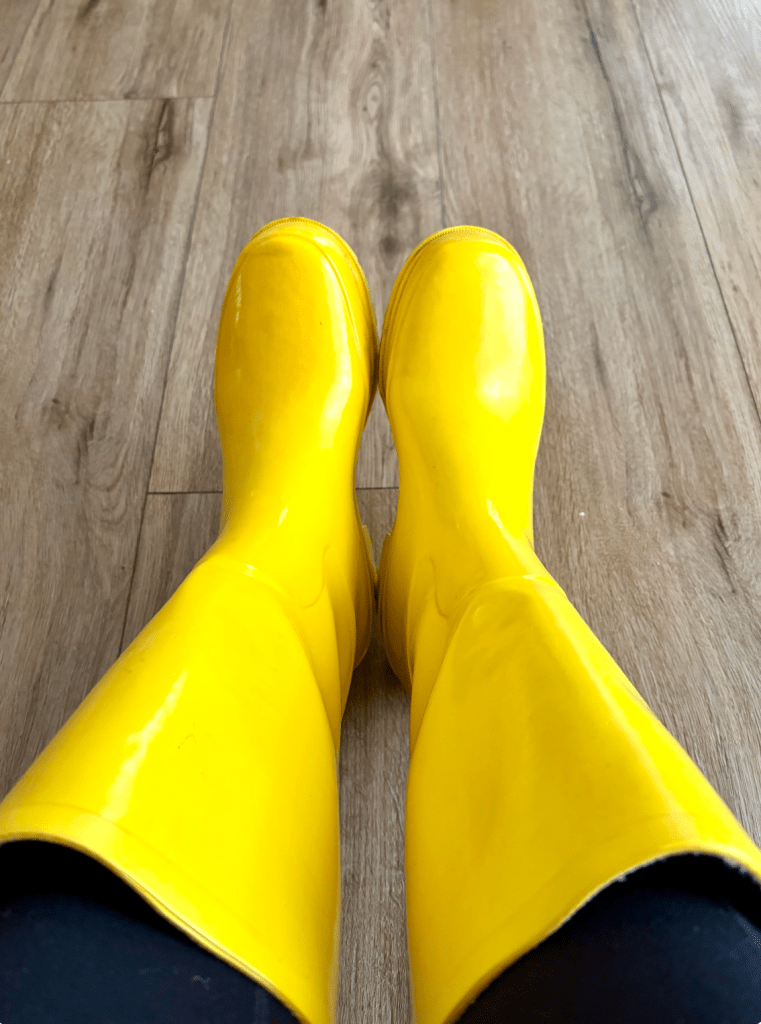
I bought these Bamboo boots at Cherry Bomb at L5P in September of 2003. I remember they were probably about $100 in a time I had zero business spending $100 on a pair of shoes that were impractical, that I absolutely did not need. I did not need rain galoshes at the time; I probably needed dress shoes for work.
Here they are, three minutes ago, in June of 2026.
These boots saw me through two winters in Iowa. I remember a guy in the parking lot while I was working at Grinnell Mutual pointing at me and laughing and telling me I needed real snow shoes. But these rubber boots are completely waterproof and skid proof: perfect for snow and ice.
Most of the past 23 years, they have lived in the back of my closet.
I bought myself two pairs of Aérosoles Daria boots in 2025 and wore them near daily the entire year; I separated the soles on the brown pair, completely wearing them out. The faux patent leather pair still survives but is on its last legs probably.
And so, these are coming out and into the rotation more often, in favor of buying new boots. I wear mostly blacks and grays anyway, so a little color doesn’t hurt. And I do still love them every bit as much as I did in 2003.
I have owned these boots half my lifetime, and I’m hoping they last the rest of it.
It’s been a couple of days’ worth of introspection.
I do a lot of introspection and navel-gazing; it’s been my life’s work anyway to try to stabilize myself.
Last February or March, I got a wild hair to use glycerin soap as shampoo and at the time, I used a Mixed Chicks leave-in conditioner that I found at Publix. I chose it because it was a relatively inexpensive leave-in conditioner.
As my mental health stabilized over the summer, I returned to products that I’d loved previously: My L’Oreal Pro Longer Conditioner occasionally, kept the Mixed Chicks, but returned to my cheap V05 shampoo alternating with my Trader Joe’s 3-in-1.
The fight with grease— and consumeristic (and brutally expensive and wasteful) beauty culture has been real.
Generally with the products I usually use, I cannot go a single day between washes. And my hair absolutely has got to be washed in the morning because it cannot withstand sleeping overnight to not be greasy in the morning even with a shower right before bed.
I know people think AI is evil incarnate. I am aware of this.
What I also know is, I have used Gemini as a tool for self-care and random life-hack improvements for a little over a year.
Last week I went into Ulta to see if I could buy another one of those Tangle Teezer brushes like J got me for Christmas. They were out, but they had these little french hair pins (well, the Ulta ones weren’t little) that intrigued me. My hair is getting to the length that I like to try to pull it up. I was aware that my hair isn’t quite long enough for the big ones yet, but I came home and found this on Amazon, and they arrived last night.
So last night, I was poking around on Google and talking to Gemini about techniques to use them in my hair.
And that led me to talking about why in the world people don’t use these instead of the God-awful elastics that inevitably tear half my hair out and get lost and you have to buy a million of over a lifetime.
And that led me to wondering how my grandparents and great-grandparents would have used to keep their hair clean. I was keenly aware that neither of my grandmothers struggled with the massive grease I did in their younger years, washing their hair only once a week often. My Mom’s mom did that in her elderly years even. I never knew Nannie to ever wash her hair more often than once a week and she went to the “beauty shop” to do so as long as she was physically able to, in fact, my whole life.
Turns out, apparently the glycerin soap I had experimented with last Spring was actually among the products that would have been used back in the day, before consumerism took over us all.
And last night before bed, I took a shower using glycerin soap all over including my hair, and I rinsed my hair using two teaspoons of vinegar in a cup of cool water, as Gemini instructed.
And having gotten a relaxing shower before bedtime, and feeling clean and not overly stripped of oils in my hair or skin, I woke up feeling fantastic. I didn’t need an alarm to wake up, I woke up rested, and I woke up ready to go straight out of the bed. I just washed my face, brushed my teeth, and got dressed and that was it.
And it remains to be seen how my hair will feel in the morning, but 24 hours later with having had my hair half-up most of the day, I can honestly say that my hair does not feel greasy. And more: apparently my natural hair, at least the underside of it that is exposed when it is half-up, when left to its own devices has this sort of wave to it that I tried desperately to get it to do with a curling iron for most of my teens and 20s and early 30s anyway. I just didn’t know it needed to not be stripped of its oils through consumeristic shampoos and conditioners.
I’m on a mission in 2026. I’ll be working through my guided journal, but also: I’m jumping off the consumer bandwagon as much as possible. Yes, hopefully it will save money. But I’m more interested in it saving my sanity.
And if I can take my showers at night instead of in the morning, it will make sleep more relaxing which will make mood regulation better which will make life happier.
It didn’t exactly start with the hair pins…..it started with the hunt for boots since my beloved Aerosoles I have been wearing since February are falling apart.
So 8-inch L.L. Bean Boots are on the way with the intention of them being my “forever” boots.
And the bronze metal French hair pins will last for as long as I have hair.
And I am falling in love all over again with my 80mm GFX lens, which took this shot at Hobbs Farm tonight.
And for better or worse, the introspection and dialogue with Gemini about why so much of our culture resists a “buy it once” mentality led me to realize exactly how counter-cultural such a mentality really is.
For instance: last March when I needed new glasses, I sent my old Warby Parker Holcomb glasses off through Costco to have new lenses put in them. I’ve worn them off and on all year.
And instead of buying disposable soft contact lenses, I opted for rigid gas permeable contacts instead, because they would help me see better, I could more easily reuse them, and they were durable enough to last longer than a year. I now have two pair that I hope to have last at least 2.5 years.
And when the flex spending rolls over, I am sending off my geometric Menin Zeelool (crazy) glasses through Costco to have my current prescription outfitted in them instead of buying new frames.
And while the Bean Boots are on the way, I did repair the Aerosoles and they’re likely not going anywhere for a good while.
But Gemini had a point: my great-grandmothers and my grandmothers in their youth would have purchased things that they knew would last, and would certainly not have gone shopping as “retail therapy.”
That was not an option in the Great Depression for any of them.
And I am more fortunate and I do realize I have the luxury of introspection and the time to research into “buy it once” sorts of culture. And the education to sort out what really does need to be modern vs what, just maybe, people in the 1920s and 1930s did better than we do today, lifestyle-wise.